- Home
- Archival research
Archival research: finding the entry
The first job is to find where your ancestor was written down: the register, the year, the page. Everything else follows from that entry.
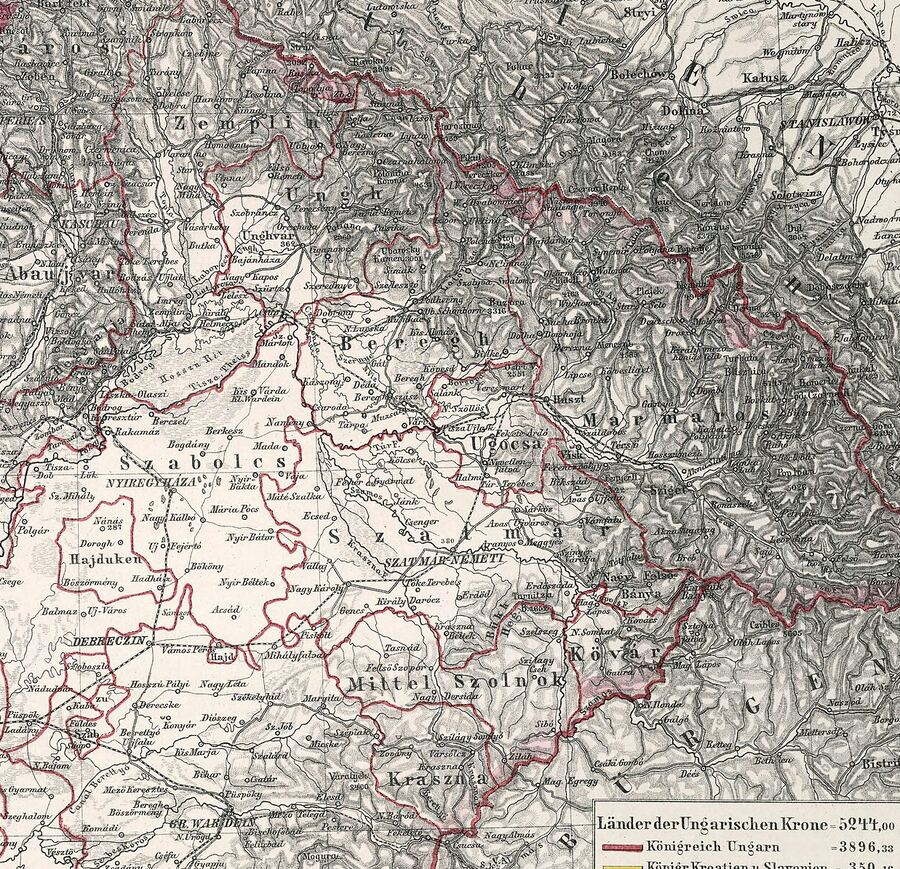
I look for the entry of your ancestor’s birth, marriage or death in the register where it was made, and I report in writing what was found, with the exact reference, so that an official copy can be ordered.
Two periods, two kinds of register
From 1 October 1895 the state registered every birth, marriage and death in Hungary, whatever the religion. The registers were kept at the local registry office, and a second copy went to the county archive.
Before 1 October 1895 the official record was the register of the church or religious community: Roman Catholic, Greek Catholic, Orthodox, Calvinist, Lutheran or Jewish. From 1828 these registers were kept in two copies, and the second copies went to the archives.
The National Archives of Hungary holds microfilm of the pre-1895 registers for the places inside today’s Hungary. Its online list shows which towns have registers, of which religion and for which years. It does not show any names. Someone has to read the films.
What I need to begin
- The place. The archive itself calls the place name the most important piece of information.
- The religion, because before 1895 each religion had its own book.
- A rough date. The bigger the town, the closer the date has to be.
If one of these is missing, the search starts with the papers your family has abroad. They usually name the town.
How a search is done
The work goes backwards in time: from a known person to the parents, then to their marriage, then to their births. Each entry names the next generation.
It is rarely a straight line. Small villages were written into the register of a larger town nearby. Names were written by ear, so one family can appear under several spellings. A page can be missing. When the direct entry cannot be found, the entries of brothers and sisters, a later marriage entry or a death entry often give the same facts.
What you receive
- A written report: which archive, which register and which years were searched.
- Each entry that was found, copied out and translated into English.
- The reference of each entry, so an official copy can be ordered.
- What was not found, said just as clearly.
- The next step I would take, and whether I think it is worth taking.
Not every register survives, and recent registers are closed to research. Before I take on a search I tell you in writing what the chances look like.
Questions about the search
What do you need from me to start?
The town or village is the most important thing. After that the religion of the family and a rough year. If you do not know the town, send what the family has: naturalisation papers, a passenger list, a marriage contract, a gravestone, old letters. The town is usually written in one of them.
Can I not simply ask the archive?
You can ask, and with an exact place, date and religion the archive may find one entry for you. But the National Archives of Hungary states that its staff do not carry out genealogical research for users, and it suggests hiring a genealogist if you cannot come to the research room yourself.
What if nothing is found?
Then the report says so, and says exactly which registers and years were searched, so that nobody searches them again. A negative result often points to the next place to look: a neighbouring town, a district register, or a different spelling of the name.
Do you search recent records too?
Recent state registers are protected for many decades and are not open to family researchers. For those, the way is an official certificate requested in your own name. See document retrieval.
Where these facts come from
- National Archives of Hungary, “Parish registers” (mnl.gov.hu)
- National Archives of Hungary, “Family research” (mnl.gov.hu)
- National Archives of Hungary, “First steps in family history research” (mnl.gov.hu)
From the archive to your file
Start with what you know.
A name, a town, a year. Even fragments are enough to begin. You get a written answer.