After 1 October 1895 the record is in a state register: the original at the local registry office, a second copy in the county archive. Before that date it is in the register of the family’s religion. If the town is outside today’s Hungary, both are kept by the country that has the town now.
The quick table
| When | What kind of record | Where it is kept (towns in today’s Hungary) |
|---|---|---|
| From 1 Oct 1895 | State register of births, marriages and deaths | Original at the local registry office. Second copy, made until the end of 1980, in the county archive. |
| 1828 to 1895 | Church or Jewish register, kept in two copies | One copy with the church or community, the second in the archives. Microfilm at the National Archives of Hungary. |
| Before 1828 | Church register, usually one copy | With the church or its archive; filmed copies at the National Archives where they exist. |
When each religion began to keep registers
- Roman Catholic: ordered in 1611 and made general from 1625. In much of the country regular registers begin only after the Turkish wars.
- Protestant churches: full right to keep their own registers from 1785, in some places much earlier.
- Jewish communities: regular, compulsory registration from July 1851, in some places earlier.
From 1822 the churches were made to add alphabetical name lists to the registers, which makes later books much faster to search.
The National Archives of Hungary
Its microfilm collection holds the pre-1895 registers of the places inside today’s Hungary: Roman Catholic, Greek Catholic, Greek Orthodox, Calvinist, Lutheran and Jewish. Most of it was filmed between 1959 and 1967 and runs to about four million frames.
The archive’s online database tells you whether a place has registers, of which religion, for which years, and the film numbers. It has no personal names. The archive also states that its staff do not do family research for users.
State registers after 1895: closed for a long time
State registers are protected for many years after an entry is made. The archive’s own pages give different figures: one speaks of 90, 60 and 30 years for births, marriages and deaths; another of 130, 86 and 30 years. One of them adds that in practice these registers are not accessible to family researchers at all.
What this means for you: for the twentieth century, the way to a record is usually not research in an archive but an official certificate, requested by the person entitled to it. See document retrieval.
Records that are not registers
When a register does not answer the question, other papers can:
- Census returns, including the censuses of Jews.
- School registers, voter lists and records of people moving in and out of a town.
- Name-change records.
- Court, property and tax records.
Outside today’s Hungary
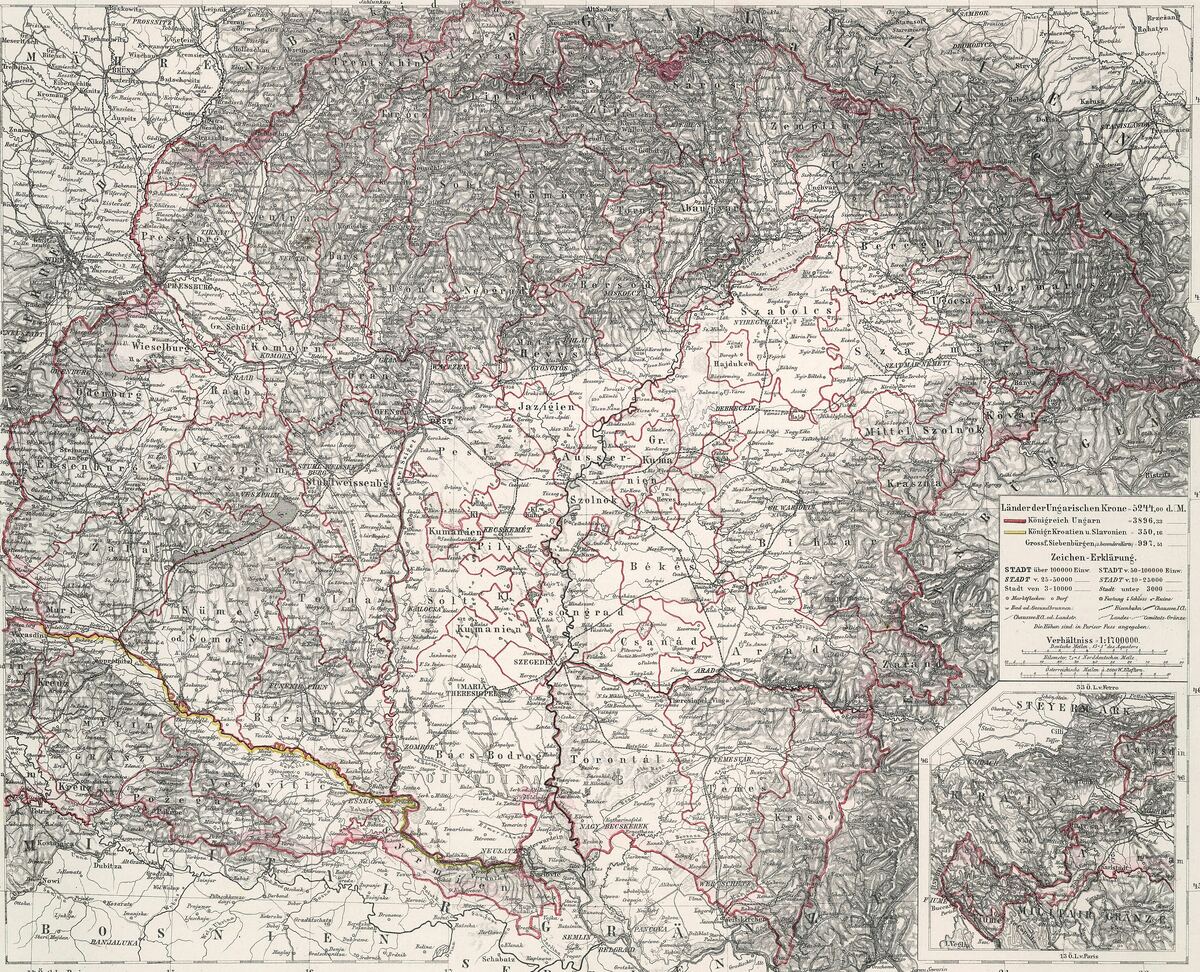
For Slovakia, Ukraine, Romania, Serbia, Croatia and Austria, see towns no longer in Hungary.
Where these facts come from
- National Archives of Hungary, “Parish registers” (mnl.gov.hu)
- National Archives of Hungary, “Family research” (mnl.gov.hu)
- National Archives of Hungary, “First steps in family history research” (mnl.gov.hu)
From the archive to your file
Start with what you know.
A name, a town, a year. Even fragments are enough to begin. You get a written answer.